Carolyn and Peter Hammond, Journal 29 2020
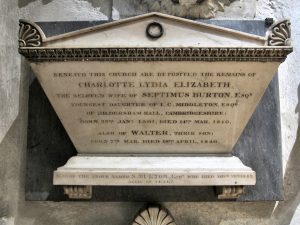
In the Devonshire Archives at Chatsworth House, along with much other material relating to Chiswick, is an auction catalogue for the sale of almost the entire contents of Grove House in 1842. The Duke of Devonshire had bought Grove House in 1831 and rented it out – his tenant in 1842 was a wealthy lawyer, Septimus Burton. Subsequently we discovered a rather poignant memorial tablet in St Nicholas’ church, Chiswick, to Charlotte Burton ‘beloved wife of Septimus Burton’ and the couple’s baby son, Walter, who both died in 1840. When Septimus himself died in 1842 it seems there was no one left to organise a memorial for him as only a brief note was added to the bottom of the existing tablet, and the contents of the family home was put up for auction. What was the story behind this reversal of fortune?The auction catalogue calls the house ‘Chiswick Grove’, it was also sometimes referred to as ‘The Grove’ but we have used the better known name ‘Grove House’.
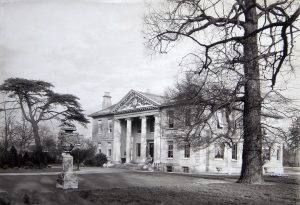
The north front of Grove House, about 1923, probably not much changed from its appearance in the 1840s. Local Studies Collection, Chiswick Library
By the middle of the nineteenth century the Duke of Devonshire owned 655 acres in Chiswick, over half the land in the parish. Since the early 1800s the family had acquired several of the large local estates including Moreton Hall, Sutton Court and Corney House. Then in 1831 the Duke of Devonshire bought Grove House (then known variously as The Grove or Chiswick Grove) and its estate for a total of £17,175. This included (to quote from the auction sale particulars) ‘a handsome stone edifice … adapted to a person of rank’, which came with extensive walled gardens, hot houses, a large conservatory and an 85 acre park.
The 1831 sale particulars stated that the house was ‘a little in need of ornamental decorations’. However the Duke went further: he had the whole of the top floor removed, reducing it to a two-storey mansion with a lower ground floor. It has been suggested that he did not want Grove House to look grander than his own Chiswick House. The house probably remained empty from 1831 to 1832, but by 1833 George Spencer Ridgway, the Duke’s Receiver, was renting it for £130 per year. He may perhaps have been living in the house to oversee the renovations.
The Burton Family
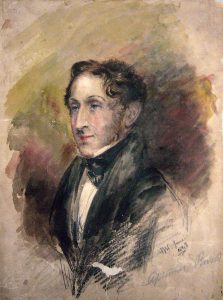
Septimus Burton, dated 1843 the year after he died, probably painted from memory. Hastings Museum & Art Gallery, HASMG.998.25.8
In 1836 a new tenant took over the house and 13 acres of the grounds. This was Septimus Burton, a wealthy solicitor who had been living in York Terrace, overlooking Regents Park. This was one of the elegant terraces designed by his architect brother Decimus and John Nash, and built by his property developer father James Burton. Decimus had been working for the Duke of Devonshire in the 1830s and it is tempting to speculate that the Duke had consulted him over the changes to Grove House, and Decimus had then told his brother about this desirable residence overlooking the River Thames
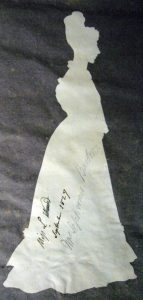
Silhouette of Charlotte Burton; the note of Miss L Wood’s name refers to another silhouette on the same page in the album. HASMG.998.25.9
Septimus and his wife Charlotte moved to Chiswick with their only child, six-year-old Arthur, but their comfortable life was not to last, for on 7 March 1840 Charlotte’s second son was born, and she died a week later. Little Walter was baptised on 27 March but he lived for only six weeks and died on 18 April. They were both buried in the church vault at St Nicholas’ church, Chiswick, and Septimus commissioned an elegant marble monument to commemorate them both with the inscription: ‘Beneath this church are deposited the remains of Charlotte Lydia Elizabeth, the beloved wife of Septimus Burton Esq… born 22 January 1801, died 14 March 1840, also of Walter their son, born 7 March, died 18 April 1840’. Sadly, only a year and a half later Septimus himself died ‘after a serious illness of a few hours only’ according to the obituary in the Gentleman’s Magazine. He was buried at St Nicholas’ church on 25 November 1842, and a brief note was added to the base of the monument: ‘also of the above named S Burton, Esq, who died November 20 1842, aged 48 years’.
Young Arthur was only 12 years old when his father died, and was probably away at school (he attended Winchester College), although he must have lived at Grove House when he was younger. There was still children’s furniture in the nursery and a rocking horse and child’s chaise stored in the greenhouse. Septimus’ will could not be proved as he had omitted to replace Charlotte as his sole executrix. However, his elder brother Henry was granted the administration of the estate, and authorised the sale of the entire contents of Grove House.
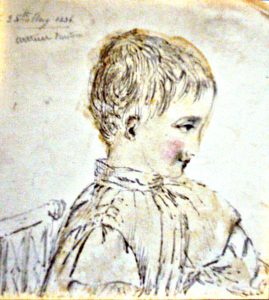
Arthur Burton, a few weeks before his 6th birthday in 1836, the year the family moved into Grove House. HASMG.998.25.1
Henry became Arthur’s legal guardian to administer the proceeds for Arthur’s ‘use and benefit until he shall attain the age of twenty-one years’. Henry saw him through school and on to Emmanuel College, Cambridge, and after Henry’s death in 1849 his younger brother Decimus took over, and oversaw Arthur’s university studies and his admission to the Inner Temple in 1854, to follow in his father’s footsteps for a career in the law. Sadly Arthur died in his 30s.
* * * * * * * * * * * * * * * * * * * * * * * * * * * *
The Auction
The auction of the ‘handsome fittings and furniture’ from Grove House was carried out by Mr Hammond, a London auctioneer. The sale was scheduled to start on December 21 and last for three days as there were 488 lots in total, ranging from the ‘handsome town built landaulet and travelling carriage’ to the plants in pots from the greenhouse. In the month between Septimus’ death and the auction sale there would have been time for other members of the Burton family (he was survived by five brothers and four sisters) to have removed some items, which would explain the surprising gaps in the contents: there were no books listed despite the presence of several bookcases, very few pictures and no silverware at all.
The auction catalogue consists of 24 pages. We do not know most of the prices raised although some items have prices pencilled against them, unfortunately only a few of the more valuable items. The contents of the principal rooms in the house are described in detail although the rooms do not seem to be listed in a particularly logical order. The contents are sometimes somewhat miscellaneous as if they had been moved there for ease of selling. The nursery for example contained a ‘quantity of crimson velvet pile carpet’ and the morning room contained both bedroom furniture and sitting room/library furniture. Rooms not mentioned, for example the laundry, probably contained nothing to be sold.
The contents of the furnished main rooms were of very high quality. All the rooms were carpeted with Wilton or Brussels carpets, some fairly massive: in the dining room was a Wilton carpet measuring 17 feet by nearly 14 feet, with a matching hearth rug. There were even bigger carpets in other rooms. Also in the dining room was a ‘very excellent Spanish mahogany dining table on large reeded legs’, 13 feet by 5 feet, with 12 mahogany ‘eating room chairs’ with seats covered in embossed velvet. Included in the linen for sale was a ‘beautifully fine figured damask table cloth’ 7 yards long, presumably for this table, together with another 26 damask table cloths of different lengths and nearly 100 table napkins for use at different meals.
The furniture in all three main bedrooms was of good quality, almost all made of mahogany, that in the ‘principal bedroom’ was of higher quality, including, amongst much else, a Spanish mahogany ‘winged wardrobe’. This had two extra smaller wardrobes on each side meant principally for dresses, although in this case there was also a fitted dress closet. The four poster bed had chintz hangings which matched the curtains. The beds in all the bedrooms were equipped with feather beds, pillows and bolsters, plus three blankets each and a counterpane or quilt.
In the principal bedrooms there were a surprising number of weapons. Between them they contained an ‘expensive’ air gun, a walking stick air gun, a blunderbuss, a pair of pistols and a sword and sheath. These may have been bought as a result of the Swing Riots of the early 1830s in response to the lowering of wages on farms, and disturbances had continued through the 1830s. People may have felt they needed to be able to defend themselves.
The Burtons evidently entertained on a grand scale judging from the amount of china, glass and table linen they owned, not to mention the contents of their cellar. The most splendid china was ‘An elegant crimson and gold china dinner service (this was printed in large bold capitals in the catalogue), of 17 soup plates, 65 dinner ditto, 17 dishes in various sizes, two soup tureens, covers and stands, four sauce boats, covers and stands, four vegetable dishes and covers and salad bowl’. They also had a white and gold tea service of 18 cups and saucers, and a matching one for coffee, as well as a ‘handsome blue and white dinner service of 70 pieces’ and large quantities of other china. There was much cut and engraved glass, including five engraved Venetian goblets, 14 decanters and large numbers of glasses for liqueurs, champagne and various wines. Interestingly no silver is mentioned, that had probably been removed before the sale although there was much ordinary cutlery in the Butler’s Pantry, including no fewer than 67 ivory-handled knives, probably steel.
The auction particulars mention a ‘small cellar of choice wines’ but in fact two cellars, with 12 storage bins in one and five in the other, were also listed. There was a considerable quantity of wine, much of it German, but also including nearly 19 dozen bottles of Madeira. There was sherry, brandy, rum, gin, liqueurs and 30 bottles of champagne; no beer as such, but 58 bottles of porter and many bottles of cyder and perry. The kitchen was fully equipped to provide sumptuous meals although the knife house only contained a quantity of empty bottles. Invitations to dinner parties at Grove House must have been much sought after.
An interesting feature of the furnishing in the morning room and saloon is the presence of several musical instruments. In the morning room was a ‘brilliant tone 6-octave cabinet piano forte by Broadwood in a mahogany case enriched with ormolu’ and in the saloon was a ‘6 ½ octave horizontal grand piano forte by Schauz’, an eighteenth century German piano maker. There was also a ‘powerful tone Finger Organ, in a noble Spanish mahogany case’ with pedals and many different stops. (At that time the term ‘finger organ’ was used to distinguish a pipe organ with manuals from a barrel organ). This organ was noted as having been built by ‘Bryceson’; Henry Bryceson was a well known organ builder in the mid 19th century. The organ was obviously a magnificent instrument, and apparently sold for £52.10s (roughly equivalent to about £5,200 today). There was also a ‘handsome mahogany double rising music stand with candelabra on reeded pillar’. It appears that the Burtons took performing music very seriously.
As well as the ordinary furniture there were several splendid clocks including a ‘magnificent Louis XIV Parisian bracket clock in a handsome buhl case richly decorated with ormolu’, and an ‘elegant 8-day Parisian mantel clock in a handsome ormolu case with stand and glass shade’. Another interesting set of items is the collection of busts of literary figures, politicians, gods, philosophers and so on, 21 of them in the entrance hall and lobbies, and also some in the other rooms. In the dining room were two ‘colossal’ busts, one of Ajax and one of Hercules. There was also a bust of Demosthenes. The morning room only had two busts, of Locke and Newton, while the saloon contained a number of antique bronzes as well as two painted porcelain ‘Medician’ vases, said to have belonged to Napoleon Bonaparte.
Only 14 pictures are listed, none of them apparently very special. This is not many for such a large house, and probably the best pictures had already been removed. When the contents of Grove House were again up for auction, after the death of Col Shipway in 1928, there were 70 paintings with a further 60 lots of prints and drawings adorning the walls of the same house. Two ‘pictures’ not removed were copies of Greenwood’s 1826 map of London and Phillips’ 1821 map of England, both mounted on rollers. These were very large – Greenwood’s was over six feet wide – so this may be why they were still in the house.
Only two servants’ bedrooms are described, and these had very little in them. A man servant’s room had a wainscot press bedstead with bedding, two wood chairs and a table, and some trays and knife boxes, and a ‘servant’s bedroom’ contained a half tester bed with bedding, a wash stand, chest of drawers and also a Dutch clock, probably a wall clock. It is difficult to tell where these rooms were situated, but they were presumably in a section of the first floor set aside for servants’ rooms. In addition there was also a housemaid’s room, containing miscellaneous equipment for looking after clothes and for cleaning, and a butler’s pantry with lamps, trays and some ordinary cutlery, but no silver. We do not know how many servants the Burtons employed when Charlotte was alive: the 1841 census shows Septimus living alone with just one man servant and a 14 year old female servant. This seems very inadequate staffing for such a large house. The census result is rather strange in that it might be expected to show either a large number of staff if the owner was present or a skeleton staff who were looking after the house while the owner was away. Perhaps Septimus had become something of a recluse?
On the third day the auction continued through some of the ground floor servants’ quarters and into the outbuildings. The carriage house contained a chaise, a travelling carriage and a four-wheel pony chaise, and there was also ‘a nearly new donkey cart’ and a ‘useful dung cart’, although the stables only contained one ‘excellent roan pony, quiet to ride or drive’, a donkey and a quiet bay horse called Billy. There were large numbers of saddles, bridles and horse and pony harnesses, suggesting that there had been more horses in the past, and there was also a side saddle that must have been used by Charlotte.
The kitchen garden contained an ‘excellent crop of vegetables’ including cabbages, broccoli and celery, plus the equipment for a melon pit. There were also 28 sacks of potatoes. The family were well equipped to supply their own needs as they also owned two milch cows, three sheep, pigs, chickens and rabbits and a ‘noble Newfoundland dog with chain and collar’.
Finally even the very many greenhouse plants (about 500 in all, including geraniums and cactus), the garden tools and the loads of hay and manure were also up for sale, as was a ‘very Handsome Colossal Statue of George IV, in his robes, in a fine state of preservation, on a massive pedestal’ which rather bizarrely was stored in the green house. This space seems to have become a place where miscellaneous lots were assembled – 2 targets and stands, 3 beehives, rustic garden chairs, a ‘useful’ seed cupboard, a rocking horse and a child’s chaise.
We do not know how much money the auction raised but the catalogue certainly gives a very detailed picture of life in a wealthy household in the 1840s.
Sources
This article is based on the 1842 auction catalogue for the contents of ‘Chiswick Grove’, from the Devonshire Collection Archives at Chatsworth House, reference number L21/1. Illustrations of the Burton family are from a set of Burton family albums held by Hastings Museum and Art Gallery.
The authors: Carolyn and Peter Hammond are the authors of Life in an Eighteenth Century House: Letters from the Grove, which depicts life at Grove House in the 1780s.