In the Local History Journal in 2010 we published an article describing how the 6th Duke of Devonshire planned and built the new road to Chiswick House, the road we know as Duke’s Avenue. He did this in January 1822. However this was not his only change to the Chiswick road system. At about the same time as he apparently first thought about building Duke’s Avenue he also thought about moving Burlington Lane further away from his front door. He was not the only landowner to carry out such a move, some moved whole villages to improve their view. Both of these changes were almost certainly inspired by the Chiswick enclosure of the Common Field which was then being carried out. Enclosure, that is converting common land into private property, was generally used as an opportunity for landowners to consolidate scattered holdings of land both in the common lands enclosed and in other parts of the parish. The opportunity to build Duke’s Avenue was given by the enclosure of the Common Field which meant the Duke now owned the land across which he wanted to build the new road. Similarly enclosure gave the Duke all of the land south of Burlington Lane into which he could move the lane.
In the division of the Common Field the Vicar was allocated what became the area of the Glebe Estate in exchange for the Glebe land in the ‘north part of Avenue Meadow fronting Chiswick House’ [Act 54 Geo III, 18 May 1814, p.9]. The Duke was to pay all expenses of the Vicar and himself. Plans for this exchange were evidently in hand before the Enclosure Act was actually passed, since in late 1813 the then Vicar of Chiswick, Thomas Bowerbank, wrote to the Duke about this exchange, saying that it had been suggested to him by the Duke’s agent in December 1812 and he had obtained the permission of the Dean and Chapter of St Pauls, the patrons of the living. In his letter Bowerbank anxiously assured the Duke that he was still eager to show his respect for him by making this exchange, but that neither he nor the Dean had heard anything about how matters were progressing, and what seemed to concern the Vicar more, that nothing had been done about closing the paths over the land he had been allotted, as he had been assured they would be. Bowerbank also pointed out that the terms of a previous exchange in 1809 between his predecessor, Mr Pretyman, and the then Duke had never been fully implemented, chiefly it seems in the matter of promised payment. Bowerbank’s letter seems to have speeded matters up as will be seen [Devonshire Mss., Chatsworth, L21/21, letter of Bowerbank]
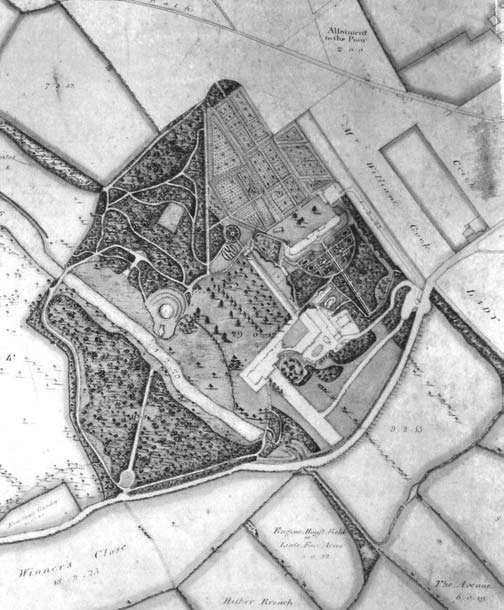
Avenue Field was then a long narrow field stretching from Burlington Lane down to the river from a point near what is now the main entrance to Chiswick House grounds. Some of the Glebe lands were at the top of the field bordering Burlington Lane. The rest of Avenue Field was already owned by the Duke and was between other fields owned by him. Owning this portion of the Glebe land would give the Duke control over all the land he needed to move Burlington Lane. After the exchange had been agreed with Bowerbank the next recorded action by the Duke is a report from his Counsel on the best way to legally pursue the next part of the plan to move Burlington Lane. The report is dated 27 August 1814, soon after the passing of the Enclosure Act, and discussed at great length which legislation to use [Devonshire Mss., Chatsworth, L21/23. The report takes up three foolscap pages]
The Enclosure Acts (both general and Chiswick specific) allowed for the moving or stopping up of old or redundant roads. The powers were originally set out in the General Highways Act of 13 George III, c.78 (1773) and this allowed a road, byway etc to be stopped up or moved provided that a new one was at least as ‘commodious’ or as convenient to the public as the old one. Two Justices of the Peace had to inspect both roads, or at least the route of the new one, and issue an order certifying that the new one complied with the provisions in the Act. In the case of the Enclosure Acts the order had to be made by the Enclosure Commissioners plus two JPs. Counsel was of the opinion that legally it was safer to use the powers of the General Highways Act to move the road and thus only need to involve two JPs.
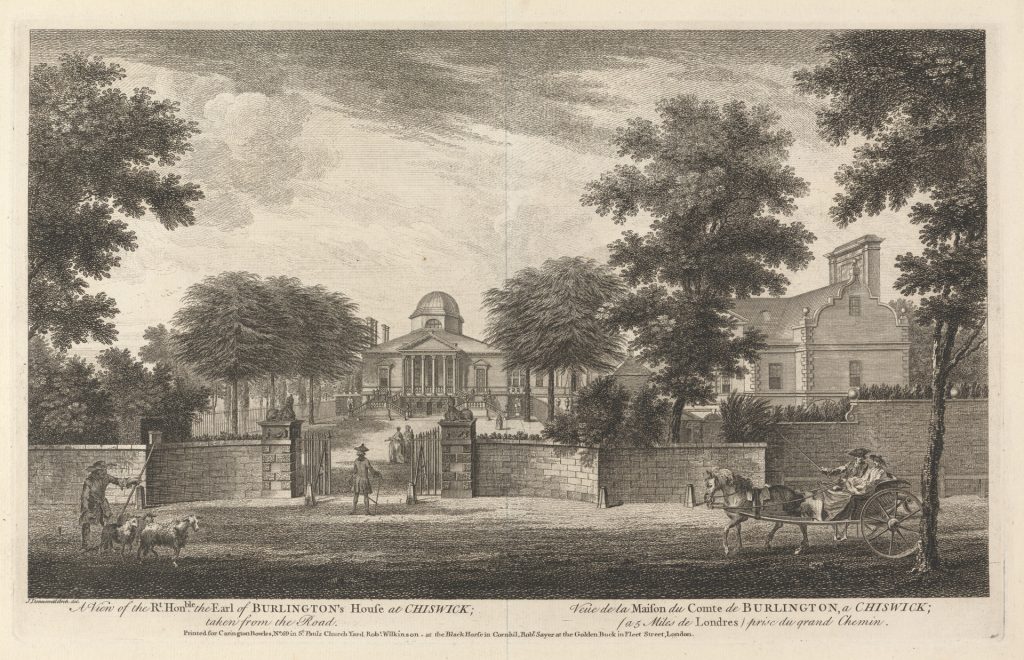
Two JPs were therefore engaged to examine the situation. They met at the Pack Horse and Talbot public house on 10 October 1814, and considered moving Burlington Lane from a point ‘lying between the North End of a Lane called Corney Lane and a spot being 90 feet west from a certain Drain called the Canal Drain, being of the length of about 370 yards or thereabouts’ to a route passing through the lands of the Duke of Devonshire of the length of 420 yards or thereabouts. That is from a point next to what is now Corney Road, where it goes down by the Convent, to a point just past the outflow of the lake in Chiswick House grounds. The curve described by the new road can be seen on the Peter Potter map of 1818 as can part of the old road running parallel but north of the new one. The new turning circle for carriages can also be seen at the beginning of the new road. The Duke provided evidence that he agreed to the new road being made through his land and the Justices ordered that the road be diverted as described, and made to a width of not more than 30 feet as prescribed by the General Highways Act of 1773. They further ordered that a rate not greater than 6d in the pound could be levied to pay for the new road. Since the Duke had agreed to pay all the expenses of enclosure this was presumably not levied. It would not have been popular among those rate payers who had not benefited by the enclosure.
The Duke signed the evidence provided to the Justices, or signed the draft at least, on 18 September 1814. The road was presumably moved at some point after the date of the order on 10 October 1814 and the Duke then had a more impressive approach to the front of his house.
Peter Hammond is Treasurer of this Society, and co-author with his wife Carolyn of Chiswick (1994), Chiswick Then and Now (2003) and Chiswick Through Time (2010).