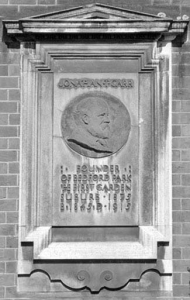
With the aid of recently-digitized indexes, the previously rather unclear relationship of Jonathan Thomas Carr, the founder of Bedford Park, to his siblings has been established, together with an outline of their lives. The connection of the family with Bedford Park has emerged as being rather stronger than was previously known.
It has often been stated that Jonathan Thomas Carr, the founder of Bedford Park, was one of a family of at least ten, but details of this comparatively large family have been scarce. One of his younger brothers, Robert James Ewing Carr, a solicitor, is known to have been involved in the development of Bedford Park, as was another brother, Richardson Carr, to a smaller extent. A third brother, Joseph William Comyns Carr, is generally thought to have played some part in giving publicity to the new development, but details of the brothers’ relative places in the family have not been known, partly at least because the older members of the family were born in Ireland, where civil registration of births, marriages, and deaths started too late to be of use, and whose census records from the relevant period have not survived.
Over the past decade, rapid advances have been made in the digitization of UK records, making searches much easier than was previously the case, principally because of the provision of name indexing of census, birth, marriage, and death records. Advantage has been taken of these new facilities to compile the brief family history given below.
The parents and grandparents
Jonathan Thomas Carr and his siblings were the children of Jonathan Carr (1808–1881), who was of Cumberland stock, and Catherine Grace Carr (née Comyns, c.1817–1876), who was born in Ireland. The baptismal register for Castle Sowerby, Cumberland records that Jonathan Carr was baptised on 11 December 1808, the fifth of 13 children baptised between 1798 and 1822 of another Jonathan Carr, farmer, and his wife Mary, née Richardson. Jonathan Carr senior is recorded as being born in 1771, and buried on 25 July 1820, and Mary Carr, a widow, born about 1778, is recorded at Johnby in Cumberland in the 1841, 1851, and 1861 censuses.
Although the Carrs seem to have been modest farmers, Jonathan Thomas Carr’s father Jonathan had become involved in the wool trade, working for the family firm of Jonathan Carr and Sons, of which he became senior partner about 1850. The birth- places of his children show that he was in Ireland from at least the late 1830s, but had moved to the London area by October 1847. These dates suggest that the return was prompted by a call to take over the family firm.
The siblings
Jonathan Thomas Carr’s younger brother J W Comyns Carr, in a book of reminiscences, says that he was the seventh of ten children, but his wife’s reminiscences of him say that her mother-in-law had borne thirteen children and had reared eleven. The records of the family in the censuses of 1851 and 1861 establish the survival of ten children and give no indication of an eleventh. It was normal in Victorian times for some children to die young, even in comparatively prosperous families, and the term ‘reared’ leaves room for uncertainty as to the age at which the eleventh surviving child, if there was one, died. There are certainly some gaps between the birth dates of the surviving children which could have accommodated those who died young, as is shown in the details below.
The available census records, supplemented by those of births, marriages, and deaths, show that four girls and then Jonathan T Carr were born in Ireland, then another three boys were born in England, fol- lowed by another girl and a final boy, making a curi- ously balanced family distribution. The list of sib- lings is as follows:
Eliza Hannah Carr was born in Dublin in 1839. She married Richard Gaskell, a cotton broker, in 1863, and went to live with him near Liverpool. She bore three children, but died of a uterine haemorr- hage early in 1871 at the age of 31. There is no very obvious route by which Eliza Hannah could have met her future husband, who was about ten years older than she. He eventually remarried in 1883, and seems to have come to live in Bedford Park as a consequence, as he is recorded as ‘of 13 Bedford Road’ when he died, apparently rather suddenly, in 1886. The informant recorded on his death certifi- cate is R J E Carr, ‘brother-in-law’, which establish- es that the family link was being maintained, despite the death of his first wife, the blood relative. Only three months earlier, Gaskell had acted as mortgagee for a few Bedford Park properties, although the records of the transactions give his address as Newcastle, Staffordshire, where he had gone to man- age a pottery some years before.
Mary Carr was born in Dublin about 1840–41. She married James Albert Wrigley, woollen manufactur- er, in 1865, no doubt having met him through family connections with the wool trade, and went to live with him near Huddersfield. She bore ten children, of whom five died young, and lived to be 81. Her husband, who was a year or two older than she, also had a long life, dying at the age of 80.
Catherine Grace Carr was born about 1841–42 in Dublin. As she had the same names as her mother, she was known in the family and outside as Kate or Katie. She studied to become a painter, and established herself as Kate Carr before marrying comparatively late in life, in 1877, a solicitor, Alfred Gardiner Hastings. He was a partner of one of Jonathan Thomas Carr’s frequent mortgagees, which is probably the route through which the couple met. Kate bore two sons, the younger of whom became the distinguished barrister Sir Patrick Hastings QC who, amongst other achievements, was the Attorney General in the first Labour Government, which was in power for most of 1924. Kate resumed her artistic career after her sons had been born, this time under the name Kate Gardiner Hastings. She appears in reference works under both names.
Kate and her husband, who seems to have been somewhat wayward and unreliable, being declared bankrupt on three occasions, spent a good deal of time living apart. At times, she was forced to live abroad, where the cost of living was lower than in England, but the couple were together again, in very reduced circumstances, by the time of the 1911 cen- sus. He died rather suddenly in the early hours of Boxing Day 1916, at the age of 69, when the couple were living at Brook Green, Hammersmith. Kate survived until 1925, dying at the age of 83.
Frances (Fanny) Ann Comyns Carr was born in Dublin about 1843–44, and died of epilepsy at the age of 50 in 1894. She is a rather shadowy figure, as she never married. It could be that epilepsy limited her options, and she was still living with her father when he died in late 1881. She died at 5 Fairfax Road, Bedford Park, the home of a female sculptor, one Miss Stiff.
Jonathan Thomas Carr was born in Dublin on 3 December 1845. As the eldest son, he was named after his father, and followed him into the family business as a woollen warehouseman. His obituary records that he had acted as political secretary to John Stuart Mill when the latter stood for election as an MP in 1865, although declining to campaign personally. In 1873, he married Agnes Fulton, daughter of Hamilton Henry Fulton of Bedford House, Acton Green. It is not at all clear how the couple met. It is usually stated that they started their married life at Trevor Terrace, Knightsbridge, but the first of their two sons, Horace Fulton, was born in 1874 at West Hill, Wandsworth, which his father, as informant at the registration of the birth, also gave as his address. The second son and only other child, Jonathan Fulton, was born in October 1875 at Bedford House. In registering this birth, Jonathan Thomas Carr gave his address as Trevor Terrace, suggesting that his wife had retreated to her parents’ home to give birth, just as the Bedford Park development was starting.
Although Jonathan Thomas had frequent problems with creditors from the early 1880s onwards, it seems likely that had he confined himself to the Bedford Park development, he would have avoided major financial disaster: Andrew Saint has shown that Carr’s financial problems stemmed mainly from the ambitious building projects on which he embarked after selling his interests in Bedford Park. Nevertheless, it was not until 1911 that Jonathan Thomas Carr was formally declared bankrupt, after a record number of 352 petitions had been brought against him.
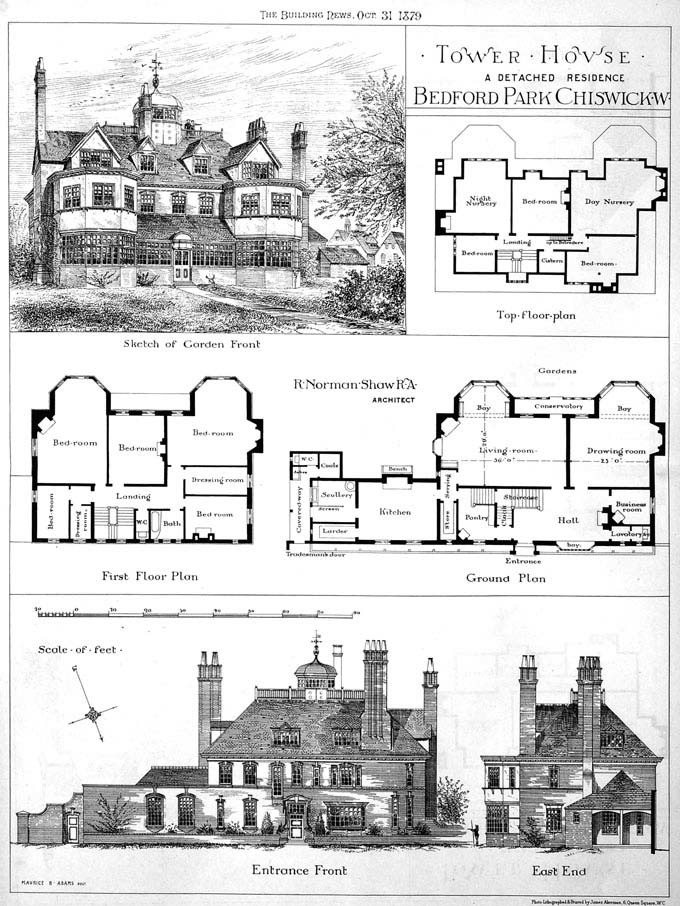
The eldest son, Horace, died in 1900, and Agnes Carr died in 1902 of rectal cancer, and in about 1904 Jonathan Thomas had to leave his Bedford Park mansion, the Tower House. He moved with his surviving son, Jonathan Fulton Carr, to 5 Addison Road (now Addison Grove). They moved again to 13 Queen Anne’s Grove in mid-1914, shortly before Jonathan’s death from a stroke on 1 February 1915. Number 13 Queen Anne’s Grove was destroyed during the Second World War.
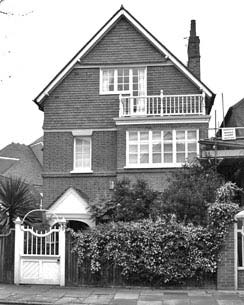
David Alexander Carr was the first sibling to be born in England, actually in Marylebone, on 5 October 1847. He was successively a civil engineer, an artist, and an architect. In 1880, he married a sister-in- law, Helen Matilda Wrigley (sister of his sister Mary’s husband James Albert), and they had one daughter. He lived in Bedford Park, at 44 Woodstock Road, between about 1894 and 1914/1915, although he also had an address in Devon from at least 1901, when he made his first appearance in Who’s Who. Local street directories show that between about 1896 and 1904 he also occupied 2 Gainsborough Studios (now 6 Gainsborough Road) Bedford Park. He died in Devon on Christmas Day 1920 at the age of 73.
Joseph William Comyns Carr was also born in Marylebone, on 2 March 1849. He had a varied and successful life, and was undoubtedly the most publicly prominent of the siblings during their lifetimes. Starting out as a trainee stockbroker, he found the work uncongenial, and resolved to qualify as a barrister. While doing so, he did some journalism and, partly under the influence of his elder sister Kate, acquired a considerable knowledge and appreciation of art. He married in late 1873 after a rather short courtship, and decided that journalism offered a quicker route to a comfortable income than did the law.
As a journalist, playwright, and theatre manager, Comyns Carr’s achievements were largely ephemeral, but he played an influential part in the setting-up and running of the Grosvenor Gallery, which has an established place in art history, and later co-founded the New Gallery. He died in late 1916 at the age of 67.
The Comyns Carrs had three children, the youngest of whom, Arthur, like his cousin Patrick Hastings, became a distinguished barrister, Sir Arthur Strettell Comyns Carr QC. Again like his cousin, he also briefly became an MP.
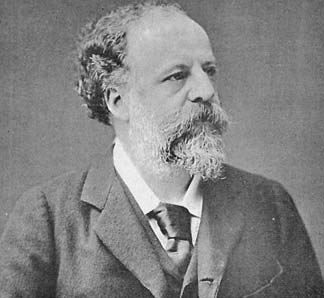
Robert James Ewing Carr was born, like his two immediately elder brothers, in Marylebone, on 31 January 1851. He qualified as a solicitor, and played a significant part in the Bedford Park development, partly in a purely legal capacity and partly as a lessee of a large number of the houses built there, almost certainly using clients’ money, perfectly legitimately, for the purpose. He married rather late in life, on Christmas Day 1893, but had no children. Rather like his brother-in-law Alfred Gardiner Hastings, to whom he seems to have been close, he appears to have been somewhat improvident or unlucky, as he was declared bankrupt in 1898. In the 1911 census, his wife, by this time a boarding house keeper in Iffley Road, Hammersmith, was recorded as head of the household in which he was residing. His address at his death in 1915 from diabetes was 65 Lillie Road, when the informant was Alfred Gardiner Hastings rather than his wife.
Sir Patrick Hastings, his nephew, wrote very warmly of ‘Uncle Bob’, whom he regarded as being of outstanding intellect, but poor in practical affairs. Hastings described Robert Carr’s life as a tragedy, despite possessing ‘a great mind and a great heart’.
Sarah Carr was born at the Manor House, Barnes, on 22 August 1852, the first girl after the run of four boys which had succeeded the initial run of four girls. In 1877, she married Charles Samuel Matthews, a physician and surgeon. Her husband, who was over ten years her senior, died at the age of 40 in 1879, leaving her with a young son. Sarah remained a widow and for a few years, from about 1888 to 1894, lived in Bedford Park, at what was then 37 Priory Road (now 43 Priory Avenue). Her son Geoffrey died there in March 1893 of diphtheria at the age of 14.
The last survivor of the Carr siblings, Sarah died at the end of 1936 at the age of 84 at the home of her nephew and executor, Frederick Charles Carr Wrigley, on the Isle of Wight.
Richardson Carr was the last of the line, born on 30 March 1857, and completing a family of five boys and five girls. Like Sarah, he was born at the Manor House, Barnes. Initially, he joined his father and brother Jonathan Thomas in the family woollen warehouse business, which was wound up after the father’s death in 1881. Thereafter, he described him- self as an estate agent, working as what nowadays would be described as a land agent for landed families, first Lord Rayleigh in Essex and later the Rothschilds at Tring. In 1881, he married a sister-in-law, Mary Fulton, sister of Agnes, the wife of Jonathan Thomas. Mary, who was some years older than her husband, died at the age of 42 in 1894, leaving Richardson with one child, a daughter. He did not remarry, and died at the age of 71 in 1928.
Family involvement in Bedford Park
As mentioned above, Robert James Ewing Carr, as well as acting as solicitor for the substantial amount of legal work arising from the development of Bedford Park, was also the initial lessee for a considerable number of Bedford Park properties. In some cases, at least, the records of later transactions state that he had been acting as trustee for Jonathan Thomas Carr. Richardson Carr also appears in some transactions relating to Bedford Park.
Jonathan Thomas Carr also involved at least two of his brothers-in-law as mortgagees. Alfred Gardiner Hastings, husband of Jonathan Carr’s artist sister Kate Comyns Carr, unfortunately found him- self on the wrong end of a Chancery suit brought by the executors of a woman, the bulk of whose fortune Hastings and a colleague had committed in 1881 to sub-mortgages by Jonathan Thomas Carr of Bedford Park properties, mainly in Priory Avenue. She died in 1882, and by early 1884, when the action was brought, the properties had decreased in value. The Court found that the investment in what it regarded as a speculative venture was a breach of trust. Richard Gaskell, widower of the eldest of the family, Eliza Hannah Carr, acted as mortgagee for some properties in Flanders Road shortly before his death, by which time he had moved to Bedford Park. It has been suggested that the fact that Comyns Carr made no mention of Jonathan Thomas in his memoirs is suggestive of an estrangement, possibly arising from Jonathan Thomas’s financial misfortunes, but in fact the memoirs make no reference to any sibling by name. He mentions at one point in his narrative that his older sister, clearly Kate Carr, had started to study painting, and also that a sister read articles for a magazine that he was editing, but fails to identify which sister it was, although the likelihood is that it was also Kate. He also makes only passing references to his second brother (David Alexander, who was only 17 months older) as a companion on fishing trips and as having started at school on the same day. The Grosvenor Gallery, of which Comyns Carr was a director, had a library which lent books to the Bedford Park Club, at least in the early days of both.
There were a number of people who lived in Bedford Park and who were part of the Comyns Carrs’ circle. One of these was James Sime, about whom both wrote warmly. Others included the actor William Terriss, who had been a school contemporary of Comyns and David Carr and possibly of Jonathan Thomas. Terriss was assassinated in 1897. The playwright Arthur Wing Pinero was also a friend of the Comyns Carrs and a resident of Bedford Park.
As mentioned above, David Alexander Carr lived in Bedford Park between about 1894 and 1915 and during the period 1896-1904 also had one of the studios in Gainsborough Road which, although not part of Jonathan Carr’s development, were on land which he had at one time held, which suggests that there was no breach between this pair of brothers. Again as mentioned above, Frances Ann Comyns Carr died at 5 Fairfax Road, Bedford Park in 1894, and Sarah Matthews (née Carr) lived for a time at what is now 43 Priory Avenue.
Sources and Acknowledgements
The principal records consulted are those of the various censuses, and of births, marriages, and deaths. Lawrence Duttson, generously passed on his records of the Carr family, including some research into the Cumberland background of the family. He also drew my attention to the connection with the family of Sir Patrick Hastings, whose memoirs throw such a useful light on two of the more obscure members of the Carr family. Andrew Saint, supplied information about Richardson Carr’s later career. Records in the National Archives, London Metropolitan Archives, British Library, and London Library, as well as the General Register Office, have been drawn upon, and extra information has come from the directories and Chiswick Rate Books held at Chiswick Library and the Electoral Registers held at Ealing Library.
Full references are given in DWB Notes on Bedford Park History No.107, ‘Jonathan Thomas Carr (1845–1915) and His Siblings’, copies of which have been deposited in Chiswick and Ealing Libraries.
David W Budworth is a retired scientist who has lived in Bedford Park for 40 years.