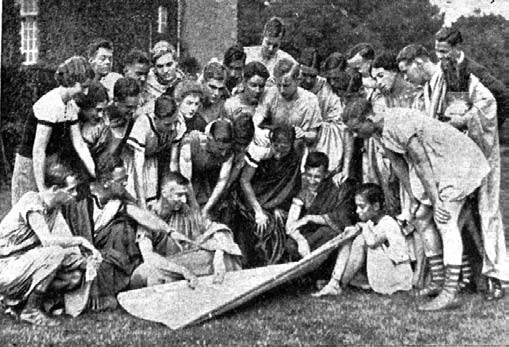
On Friday 18th August 1933, 24 boys from the Dramatic Society of Chiswick County School for Boys set off for a four week tour of Germany accompanied by three teachers – Mr Kitchen, Mr Westgate Smith and Mr Garlich. Mrs Garlich also went along as ‘wardrobe mistress’ to look after the costumes for the plays they were to perform.
They travelled extensively for a month, going as far north as Bremen and as far east as Berlin, taking in a trip to the Harz Mountains, and coming back via Hanover to cross the border at Aachen. They performed Shakespeare’s Julius Caesar and Goldsmith’s She Stoops to Conquer in the open air, in town halls, schools, youth hostels and twice in a castle, including a performance before Count von Hatzfeld and a small house party at Crottdorf Castle. The Count’s father had been the German ambassador in London before the First World War.
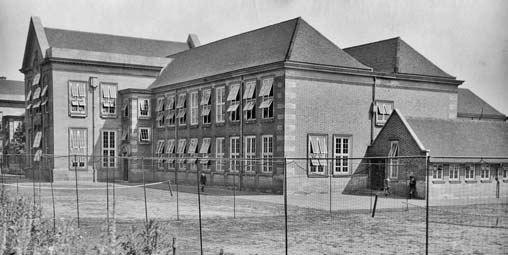
On tour – and sightseeing
A special performance of Julius Caesar had been given at the school in April to raise funds for the trip, and the costumes had been made by parents and friends, so the cost to each boy was only ten pounds. The trip was excellently organised through contacts in Germany, and the boys stayed in youth hostels or with families. One of the boys, Geoffrey Edwards, sent reports each week to the Brentford and Chiswick Times and wrote of the generous hospitality they enjoyed during the trip.
In the second week the party travelled from Bremen to Osnabrück, where they performed Julius Caesar and heard a programme of music by a ‘Hitler Youth Band’. Geoffrey Edwards wrote that the band marched round the school playground and:
…we had the fact firmly impressed upon us that that was the real nature of the Hitler Youth movement, and that there was no preparation for war in their training. We frequently hear from our hosts of the injustices that their Fatherland has suffered in the past few years, and of the futility of separating East Prussia from Germany [by the Polish Corridor]. Most of the young people are keen members of the Nazi organisations.
The boys went on boat trips, visited all the sights, and during a week’s stay in Berlin went to the Broadcasting House and to the Tempelhof aerodrome from where most of the party flew over Berlin – their first experience of a flight. Everyone, reported Geoffrey, is having a thoroughly good time.
Football and handball matches were arranged with a local school’s teams. The visitors lost, and in the evening there was a dance where, as Geoffrey reported:
Our hosts, both boys and girls, danced excellently, but the visitors (we) were both shy and incompetent. Surprisingly however, we learned that we did not show the amount of reserve usually shown by Englishmen.
The evening concluded with the singing of the national anthems: ‘We sang God Save the King and our friends Deutschland über Alles.’
The garrison church and tomb of Frederick the Great at Potsdam were impressive. The glories of Germany’s illustrious past were on display – the regimental flags from the Austro-Prussian War and the 1870 war against France. At the door was a simple memorial to those who fell in the Great War. Geoffrey wrote:
Small wonder, that it was here that Hitler chose to assemble the Reichstag after the revolution, and here that he chose to inaugurate the new Germany [when he came to power earlier that year.]
The journey home
In the last two towns Geoffrey says they were largely entertained by girls who showed great regret on their departure. The party set off for home at 3.40pm on Friday 15 September, and the train stopped at Bielefeld for three minutes, where to their surprise several of their hostesses were assembled to see them off. Some of the boys got off the train to say farewell and the teachers became anxious in case anyone should be left on the platform. The party changed trains at Cologne, and waited two hours before leaving for Ostend at 1am in the morning. All went well until Belgian passport officers and customs officials, dressed in blue uniforms with red caps and carrying revolvers, boarded the train at Aachen, close to the Belgian border. Their German friends had pressed souvenirs on the boys before their departure, including swastikas, the emblem of the Nazi party, and several of the boys were wearing swastika badges on their lapels. The authorities decided they could not enter Belgium, citing a Belgian decree forbidding foreigners to wear the badge of any political party in Belgian.
Geoffrey Edwards reported that ‘the real trouble seems to be that feeling runs very high on the frontier, and a Nazi badge to a Belgian is like a red rag to a bull’. The communal passport for the 24 boys was taken from the school masters, and the party was locked in the Belgian railway station at Herbesthal for two hours before being sent back to Aachen in Germany. An English nurse who was with another party was also wearing a swastika badge and was similarly detained. Mr Garlick explained to the officials that they were English and asked to be allowed to telephone the nearest British Consul, but was told no telephone was available.
At Aachen the German officials, after the situation was explained to them, were most helpful, and assist- ed the boys to pack up their forbidden souvenirs of Hitler songs, literature and emblems, and undertook to post them to their addresses in England. The party was then able to get a train back to Herbestal and this time passed through without incident. They caught the ferry at Ostend, and the exhaust- ed party finally arrived at London Victoria just after 5pm the next day. News of the border incident had been wired ahead by a journalist who happened to be on the train, and a gathering of reporters and photographers awaited their arrival in England. The story in the Daily Mail on the following Monday morning was headlined ‘Boys Stopped on Frontier: Britons with Nazi Badges’.
Geoffrey Edwards’ final report told how every- where in Germany they were treated with the greatest kindness, and in every house were pressed to eat much more than they really needed.
Everyone is now enjoying the comforts of a real English bed. Another joy is a cup of real tea – with milk and sugar – and a good meal with a typically English pudding.
Back in England
At 88 Duke’s Avenue Regina Miriam Bloch had read Geoffrey Edwards’ Brentford and Chiswick Times reports with interest. On 22nd September a letter from Miss Bloch appeared in the newspaper saying it was a disgrace that Britain’s children should be sent on holiday in Germany under present conditions.
They can only return with false impressions of autonomous dictatorships and ideas which infringe upon the liberty and loyalty of English life. The plastic material of the child’s mind cannot be too closely protected. They might just as well spend a holiday with the Soviets next year.’
Her letter provoked responses in the next issue of the Brentford and Chiswick Times. One was from Bruce Uren, one of the boys. [In later life Mr Uren was my Geography teacher at Isleworth Grammar School and later became Head Teacher of Isleworth and Syon School]. Bruce wrote he was amused by Miss Bloch’s letter:
…while everyone was immensely interested in the great experiment being carried out in Germany, everyone returned firm supporters of English liberties … the only impressions with which we returned were of German kindness and hospitality, which we met everywhere on our extensive tour of Nazi Germany.’
Another boy wrote that Miss Bloch’s views would take us back to where we were in 1914:
The future peace of the world depends upon understanding between nations, and one of the best methods is by personal contact. Fear caused by misunderstanding and ignorance causes war, and our borough by means of the tour, has tried to do something to promote friendship between Germany and England.’
As Geoffrey Edwards had written in his last report:
…after our short stays we were very good friends with our hosts and hostesses. We hope to correspond with many of our new friends now that we are back in England.
Mr H H Palmer, whose son was on the trip, asked if Miss Bloch had first hand information, or if she merely echoed sentiments expressed in a certain section of the press:
There is bound to be a certain amount of suffering caused when a people struggle for freedom …. I cannot help feeling the criticism was offensive and an insult to the intelligence of the boys.
Two weeks later came the reply from Miss Bloch, and she wrote that:
…the less our British schoolboys learn of Nazidom, that perverted form of Fascism, which the Duce [Mussolini] himself deplores, and the less they display the swastika “the crooked cross, the antithesis of Christianity”, the better it will be for peace and liberty in this harassed world. If, as Mr Palmer says, I base my opinion upon “certain sections of the press”, I sin in the good company of (many) civilised leaders of thought.
She wrote that there seemed to be an impression that she was ignorant of Germany. She explained that she was born in Central Germany in 1891, and went to school there, but had been living in Chiswick since 1909. She was a published poet and prose fiction writer who in 1919 had launched a public appeal for the formation of a Jewish arts and crafts society. Her late father, who was headmaster of Edgbaston High School for Boys, introduced football and English sport into Germany and her mother introduced the kindergarten system into Birmingham and England. After that there was no more correspondence on this topic.
Tail-piece
Eight years after this visit to Germany, at Easter 1941, the School Dramatic Society staged another production of Julius Caesar at High Wycombe, where the school had been evacuated to avoid the London blitz. This time they chose to do it in modern dress, as a study of the evils of Fascism.
By then many of the boys who had enjoyed visiting Germany with the first production of the play in 1933 were serving in the forces fighting against their former friends. Forty three pupils from Chiswick County School for Boys lost their lives in the Second World War.
Sources
The Brentford and Chiswick Times and the archives at Chiswick School.
John Grigg was a local Labour councillor for 17 years between 1958 and 1990, and Leader of Hounslow Council in 1986. For many years he has been working his way through back copies of the local newspapers as part of his research into the political history, particularly of the Labour Movement, in South West Middlesex.